Showing posts with label fantasy. Show all posts

Friday, June 8, 2012

"Childe Roland to the Dark Tower Came" by Robert Browning


SourceLibriVox (mp3)
Length: 13 minutes
Reader: Algy Pug

The poem: In The White Company, Conan Doyle mentions the great knight Roland as the company travels from France into Spain through the Roncevaux Pass in the Pyrenees Mountains. Roland, a knight of King Charlemange, died while holding the rearguard in a battle in the pass, made famous by the French epic poem The Song of Roland.

This poem, composed hundreds of years later, follows a legendary earlier quest by Roland to the Dark Tower. Browning describes a desolate landscape full of imagery of death, reminding him of other knights who have failed this quest. Roland himself holds little hope of himself succeeding at finding the Dark Tower, but continues on anyway. Browning, perhaps, is commenting on the futility of life as well as our duty to keep living as best we can. The depressing nightmarish land described in the poem have been a inspiration to other writers, notably Steven King's The Dark Tower series and Gordon R. Dickenson's Childe Cycle.

Rating: 8 /10

The reader: Pug does an adequate job here reading a very difficult poem. He has a strong Australian accent, but it did not inhibit my understanding of the words. I did have trouble following the poem due to its complexity and had to follow along by reading the text. Each stanza heading (1, 2, 3, 4) is read out loud, which, although faithful to the text, is somewhat distracting. Though Pug's reading does little to aid the interpretation of the poem, his neutral tone is probably best for those wishing to find their own sense of meaning.

Friday, May 18, 2012

"The Truth Is a Cave in the Black Mountains" by Neil Gaiman

Source: Starship Sofa (mp3)
Length: 54 min (starts at 12 min in of a 1.5 hr episode)
Reader: Richie Smith

The story: I was a bit disappointed by this story.  Neil Gaiman is one of my favorite authors. His works, from the Sandman comics, to American Gods, to The Graveyard Book, are filled with mind-blowing ideas and a personality that is both grotesquely horrific and charmingly idealistic. When I heard that he had a story on StarShip Sofa AND the story had won the Locus Poll Award for Best Novellette, I had high expectations.

Those expectations were not met, but this is still a good story. It starts out simply: A man, small in stature, has lost a daughter. He seeks a guide to take him to the Misty Isle where there is legendary treasure in a cave. Along the way, secrets about both the man and his guide come to the surface, leading to a much more dangerous journey than it would first appear to be. The journey format seems to drag the story out longer than it should to an ending which is predicable, but satisfying. This is one of Gaiman's less memorable stories, but is a Gaiman  story and that's quality enough.

Rating: 7 /10

The reader: Richie Smith is a superb reader for this story. He has a clear voice that's easily understood. There's not much emotion in his voice, but that may be because this story is rather understated. The recording is well produced. Besides the main story, the podcast contains some additional commentary on science fiction and a old radio play. Tony, the host of Starship Sofa, has put together an excellent podcast. If it's not on your weekly listening list already, it should be.

Monday, May 14, 2012

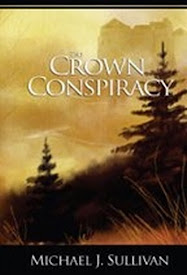
The Crown Conspiracy by Michael J. Sullivan


Source: Podiobooks
Length: Approx. 9 hrs
Reader: Nathan Lowell

The book: Literature that is innovative can be challenging and mind-changing. With the long days of  summer approaching, though, a good story with familiar elements is just as welcome. The Crown Conspiracy liberally borrows from its predecessors in the medieval fantasy genre, but lack of originality can be forgiven when the tale is told well.

The main characters here are a pair of hear-of-gold thieves distinctly reminiscent of Fritz Leiber's Fafhrd and the Gray Mouser.  The heroes get themselves into trouble through a obvious set-up and set about trying to escape from captivity and avoid their pursuers. There are some plot twists that aren't terribly surprising for anyone familiar with the genre, but the story is told with such humor and a sense of adventure that these tropes feel natural. The writing alternates between exciting set-pieces and long exposition conversations as the author fleshes out his fantasy world. This short novel is the first in a series of six, so there are some loose ends, but the book itself winds up to a satisfying conclusion.

Rating: 8 /10

The reader: As I stated in a previous review of his own book, Lowell is a gifted reader. The recording is professionally produced with appropriate music for the beginning and end of each segment, along with shorter bits of music for scene changes. If I have any complaints, it's in Lowell's voices for his characters. I found it hard to distinguish between the voices, and the uneven distributions of British accents added to the confusion. Overall, though, this was an excellent recording.

Friday, December 16, 2011

"Markheim" by Robert Louis Stevenson

Source: LibriVox (mp3)
Length: 44 minutes
Reader: William Coon

The story: In desperate need of money on Christmas Day, Markheim approaches a local pawnbroker.  Markheim's evil intentions go beyond just selling stolen goods. His deeds, however secretive, do not go unnoticed. A touch of the supernatural enters into the story, bringing the tale beyond the usual trappings of a dark crime story and into a discussion of the nature of evil and the powers of free will.

This story strongly reminded me of Crime and Punishment (previously reviewed) with both its general outline and its themes. The major difference is  the addition of the supernatural into the story. This addition allows Stevenson to open up the story into the future and past, but also into the soul of Markheim and investigate the essence of his being. With only a fraction of the length of Dostoevsky's novel, Stevenson is able to visit many of the same themes.

Rating: 8 / 10

The Reader: Coon is a superb reader. He builds the tension of this story so that the listener feels the growing psychological horror of the crime. Even though this recording dates to the early days of LibriVox, Coon's recording is clear and well-made.

photo by wallg via flickr. Creative Commons by attribution, non-commercial, no derivatives

Tuesday, December 13, 2011

The Wondersmith by Fitz-James O'Brien

Source: Maria Lectrix (Part 1 | 2 | 3 | 4 | 5 | 6 | 7 )
Length: 1 hr, 32 min
Reader: Maureen O'Brien

The story: On a back street of 19th century New York stands an odd shop labeled simply "Wondersmith." No one is quite sure what is sold there, though beautiful toy figures are arranged in the shop window. Deep within the Wondersmith store, a secret meeting is held shortly before Christmas to devise a plan to use children's gifts to advance a nefarious plot.

"The Wondersmith" is the type of racist and formulaic tale that sold lurid dime novels in the mid 1800s. The villains are evil gypsies intent on murdering Christian children. The heroine is perfect and noble as she is beautiful. Yet, despite these tropes, the story is exciting and chilling. It's easy to see why such stories sold so well to a public in search of Christmas entertainment.

Rating: 7 / 10

The reader: As the host of the Maria Lectrix podcast, Maureen O'Brien has years of experience in telling stories. Her podcast is focused on Catholic religion, but she also reads stories and books only tangentially related to religion. The archive features large number of stories, novels and religious nonfiction. All this experience shows in her reading of this story. She has a warm, expressive voice that she modulates for the different characters. She slightly alters the text of the story to replace a misused word, but otherwise the story is complete and unabridged.

photo by geekygirlnyc via flickr. Creative Commons attribution, non-commercial, no derivatives. 

Monday, October 17, 2011

The Willows by Algernon Blackwood

Source: LibriVox (zipped mp3s)
Length: 2 hours, 21 minutes
Reader: Michael Thomas Robinson

The book: Considered one of the greatest stories in horror literature, The Willows lives up to its reputation. Two friends canoeing down the Danube stop for the night on an island in the middle of a huge expanse of willow trees. The place seems mystic, almost otherworldly, and in the night the two interlopers find out why.

Blackwood could have set this story in any exotic river in the world, but he chose the Danube. This river, which runs through the heart of Europe, is the wildness that runs through what was then the epitome of civilization. As the atmosphere of this turns from idyllic to terrifying, Blackwood is showing that the unknown horrors of the world can be anywhere, even where we should be the most safe. This, I think, is the most horrifying realization of all.

Rating: 9 / 10

The reader: At first, I was not impressed by Robinson's voice. He's somewhat nasal, and starts the book with a bored, straightforward style. As the story went on, though, I realized the initial bored tone was probably intentional, contrasting with the building dread of the story. His pace quickens and slows to build the tension, drawing the listener into the horror of what the narrator is experiencing. Despite my early misgivings, I greatly enjoyed this reading.

(entered in Cym Lowell's Book Review Party Wednesday)

Tuesday, September 27, 2011

The Tempest by William Shakespeare

Source: Speak the Speech (Act I | II | III |IV| V )
Length: 2 hours
Readers: Cast directed by Cynthia McGean

The play: Opening in a great storm at sea, The Tempest is a play that's easy enough to enjoy from the beginning, but has the depth and power suggested by its name. The plot is rather simple: Prospero, the former duke of Milan,  has escaped to after his brother led a coup against him with the support of the King of Naples. Years later, Prospero summons a magical storm to ensnare the boat of his enemies. The remainder of the play consists of Prospero using magic to solve all of his own problems and foil the plots of the villains.

Yet underneath the simplistic solutions lie more problems. Is Prospero a hero or is his manipulation of those around him a troubling sign of a dark character? Is his punishment the malformed island native Caliban deserved or is Caliban the victim the oppression? Thought to be the last of Shakespeare's plays, it's apparent that the Bard sees a part of himself in the magician as he says farewell to the stage: "As you from crimes would pardon'd be, / Let your indulgence set me free."

Rating: 8 / 10

The readers: This is a full cast production with attendant sound effects and music. The sound effects are not overdone, but I found the twinkling chimes that signify Prospero's magic to be rather trite. The music is nicely performed and uses processed vocal effects to give an otherworldly feel to the fairy songs. The actors, particularly Prospero, Caliban, and Antonio, give a great performance, but it can sometimes be difficult to discern who is speaking what lines. For this reason and for the understanding of uncommon words, I recommend that listeners follow along with the text of the play. This version of the play is unabridged, Speak the Speech also offers an abridged one-hour version for download as well.

(Entered in Cym Lowell's Book Review Wednesdays)

Monday, September 5, 2011

Beowulf trans. by Francis B. Gummere

Source: Lit2Go (iTunes U)
Length: Approx. 2.5 hours
Reader: Rick Kistner

The book: Beowulf has within it exciting battles, tales of classic battles between good and evil, and insight into a way of life that is alien to our modern world. Sadly, these great qualities are buried in this difficult to understand translation. Gummere's work was published in 1910, but he chose to use archaic words apparently to evoke the old-time feel of the King James Bible.  Listening with modern ears, the words throw up a barrier to understanding, rather than making the meaning clear and the story enjoyable.

Yet, underneath the cumbersome translation, the story still shines. Beowulf's insanely brave choice to pursue Grendel to his mother's lair made me shake my head with admiration. A light bulb went off when I recognized the theft of a goblet from the dragon's lair as the inspiration for the same scene in The Hobbit by J.R.R. Tolkien. If I could only get around the awkward phrasings and archaic words, I think I would have enjoyed this classic. This is the only translation that is available in free audio that I could find, but it may be worth it to pay for a more enjoyable version.

Rating: 6 /10

The reader: Usually, I find Lit2Go's recordings to range from okay to good, but this one falls short. Kistner reads much too fast for such a complex poem. His rhythm lacks the flow of well-read poetry but is too artificial to pass as prose. In the past, I've enjoyed Kistner's readings of The Jungle and Crime and Punishment, but this one ranks below his usual work.


(entered in Cym Lowell's Book Review Party Wednesday. Follow the link for more reviews of other books)

Friday, July 22, 2011

"The Swimmer" by John Cheever

Source: The New Yorker Fiction Podcast (mp3)
Length: 43 minutes
Reader: Anne Enright

The story: One lazy summer day, Ned Merril decides to swim across the county by way of swimming pools. His bizarre Odyssey starts out fine with the first few swimming pools, but as he goes along, he dives into less appealing pools. Odd reminders of the past (or present?) pop up and his final few laps are a struggle to return to his home.

As Enright and Treisman point out, this story has a similar feel to the better episodes of The Twilight Zone. Everything starts out normal, so when the plot takes a turn to the strange, our minds try to work for an explanation. I think this desperate effort to explain is why the story has become so widely-discussed in English literature classes. Ned's journey is a microcosm of a life, with many of the most important events happening while our heads are underwater and no way to understand our situation when we come up for air.

The reader: From the first sentence of the story, Anne Enright's sense of humor comes through. As the story goes on, her writer's understanding of the flow and intricacies of the piece bring the depth of the story to light through her narration. Her discussions with New Yorker fiction editor Deborah Treisman before and after her reading are entertaining and enlightening. The podcast is nicely produced and recorded well.

(photo by mr. rollers via flickr. Creative Commons Attribution, No derivatives  Noncommercial license.)

Friday, June 24, 2011

"Queen of the Black Coast" by Robert E. Howard

Source: SFFaudio podcast (mp3)
Length: 1 hr, 20 min
Reader: Gary Kobler

The story: Long before the upcoming Conan the Barbarian movie or even the Arnold Schwarzenegger classic, Robert E. Howard created the character of Conan. This original Conan was an inversion of the classic primal vs. civilized conflict. While most stories champion civilization over red-toothed nature, Howard saw in the Wall Street collapses of his time that civilization could be the corrupt one and savagery be more noble. Conan is unashamedly barbaric in his drinking, womanizing, and violence, but the civilizations he is pitted against have rotted from their own decadence. Conan, at least, is strong enough to stand by his own warrior ethic.

In this classic story, Conan escapes a courtroom where he's asked to go against this personal code. He joins up with a merchant headed for Kush, who is overhauled by pirates. The notorious and beautiful pirate captain Belit lusts after Conan and spares his life. Together, they journey up a river to loot the treasures of a fallen empire and learn the story of its decay. Even if you're not a fan of medieval fantasy, this is a great introduction to the philosophy of Conan.

Note: This story contains adult themes and may not be suitable for children.

Rating: 8 / 10

The reader: Kobler is a professional narrator who performs this story for the Audio Realms edition of People of the Dark: The Weird Works of R.E. Howard Vol 2. Thanks go out to the publisher and SFFaudio for making this full-length story available for free. Kobler does an excellent job of capturing the excitement and suspense of Howard's writing. His voicing of Conan is a bit cartoonish, but it fits the pulpy nature of the hero. One of the weaknesses of Howard's writing is his tendency to use stereotypes for minor characters; this is reflected in Kobler's broad accents for the supporting cast. The recording itself is well-produced and professionally made.

(Image copyright Marvel Comics. Incidental use for criticism falls under the Fair Use provision.)

Tuesday, June 21, 2011

Shadowmagic by John Lenahan

Source: Podiobooks (download the first chapter)
Length: Approx. 7 hours
Reader: John Lenahan

The book: When 18 year old Connor is visited by an unexpected guest, he learns that his father is not an eccentric professor, but a prince from a magical kingdom and his mother is a witch who practices the forbidden sorcery of Shadowmagic. The premise for the book is the well-worn magical coming of age story, like a Celtic mythology version of Percy Jackson.  Like Percy Jackson, Connor is full of teenage quips and a tendency to get himself into trouble.

The plot moves forward in bursts, with plenty of action at the beginning and ends of chapters, interspersed with exposition. I found the characters uninteresting, though the setting and magic were fascinating. In reviewing this, I realize that I'm not part of the target audience of young adults, so what seems immature and trite to me may be awesome for younger readers. Lenahan's writing may be unpolished, but this is still an amusing book for fans of young adult fantasy fiction.

Rating: 6 /10

The reader: Lenahan is a talented reader. He voices his book with enthusiasm that makes it much more enjoyable than the actual story by itself. He doesn't overdo himself with difficult Irish accents, but stays within his range. The podcast is introduced by an upbeat Celtic reel that reflects the subject and tone of the book. The recording is well-produced with excellent sound quality.

Friday, April 15, 2011

"The Library of Babel" by Jorge Louis Borges

Source: mpages.org (mp3)
Length: 21 minutes
Reader: George Guidall

The story: I've always dreamed of a massive home library, with books lining every wall and shelves reaching up multiple stories. In this story, one of his most famous, Borges extends this book-love into an entire universe of books. Each of these books is different, but where did they come from and what is their meaning?

In a story stripped down to just a setting without plot or characters, Borges still manages to keep my interest and introduce some thought-provoking themes. Throughout his work, Borges is obsessed with religion, perception vs. reality, and the power of the written word. In this story, the books, some of them unintelligible, are thought by some of the residents of this universe to have a hidden meaning, and by others to be completely random, having meaning only by chance.

In our own universe, we likewise have natural feature of great complexity, but also with randomness embedded in them. Are they created by a greater Intelligence or the result of a series of random events, replicated and built up over time to build complexity? I don't think this is a necessary dichotomy. I believe that it is possible, like the people of the Library of Babel, to have things arise from random events, but still contain meaning for an observer with the intelligence to interpret it.

Rating: 8 / 10

The reader: Guidall is a professional voice actor who reads this story with a calm, scholarly tone that fits this story perfectly. With little of plot or characters, this would be an easy story for a reader to fall into a drone. Instead, Guidall uses pauses and changes in pitch to emphasize his words and changes in thought. This is a great reading of a classic story. Note: This is a commercial recording under copyright. It is unclear whether the hosting website has permission to post it.

(etching by Erik Desmazieres)

Friday, March 11, 2011

"Another End of The Empire" by Tim Pratt

Source: Podcastle (mp3)
Length: 35 minutes
Reader: Cheyenne Wright

The story: An evil emperor receives a prophesy that a child from a remote village will be his downfall. This situation, with minor alterations, could be the opening to any number of fantasy epics, including Harry Potter or The Lion, the Witch and the Wardrobe. Unlike Voldemort, however, the tyrant Mogrash has apparently read the Evil Overlord List and is able to apply his genre savvy to try to avoid making the prophesy come true by doing exactly the opposite of what all of his predecessors had done.

Tim Pratt pulls off this story by not only having a funny premise, but by also paying attention to the details. Little things like the skulls of pixies decorating the hair of the evil emperor give the story a realistic depth that makes the world seem more fully formed. The characters are parodies of stock fantasy tropes, and the plot runs along in a predictable direction, but this is a fun, enjoyable story that made me smile.

Rating: 7/10

The reader: Wright has smooth, deep baritone that enhances the telling of the story. His voices, especially the gravelly badguy voice for Mogrash, add a layer of humor to the words on the page. There's something about the incongruity of a deep scary voice whining like a child that makes me laugh. Podcastle is in the Escape Pod family of podcasts and shares their high production values.

Monday, March 7, 2011

The Lion, the Witch, and the Wardrobe by C.S. Lewis

Source: Ancient Faith Radio (part 1 | 2 | 3 | 4 | 5 | 6 | 7 | 8 | 9 )
Length: Approx. 4.5 hours
Reader: Dr. Chrissi Hart

The book: One of the classics of children's fantasy literature, The Lion, the Witch, and the Wardrobe was my favorite book as a child. I loved (and still love) the feel of the world of Narnia as a place both magically impossible and plausable, filled with characters that could never exist, but are true enough to be real. I must have read it a dozen times from second grade up to my adult years. Every time I read it, I gain a new perspective on the book. The same book that is a mind-blowing adventure story for a child is also a profound Christian allegory for an adult.

I have some non-Christian friends who think that slipping an extended metaphor for Jesus Christ's death and resurrection into a children's story is some sort of sneaky trick Lewis uses to brainwash children into becoming Christians. However, I think the presence of the allegory is part of the appeal of the story, even if I didn't recognize it as a child. Great fanasty literature puts the reader in a world that has a history and largeness that exceeds even what is shown in the book. In The Lion, the Witch and the Wardrobe, Lewis's imaginary world works on prophesies and rules that have the feel of existing beyond the scope of the book to eternity. What better way to lend a sense of mythic grandeur to a novel than to base it upon the most powerful and deep story in Western culture?

Rating: 10/10

The reader: I'm absolutely amazed that Ancient Faith was able to get permission from HarperCollins and the Lewis estate to podcast this novel. Hart has a pleasing British accent and the confidence of someone who is comfortable in front of a microphone. She makes a couple of repetition errors, but is otherwise flawless. The recording quality is very good, as is befitting such a professionally produced podcast. The other books in The Chronicles of Narnia series are also available for free through the same website, so head on over to collect all seven books.

(Entered in the Book Review Wednesday contest at Cym Lowell. Follow the link for reviews of other books by various bloggers)

Friday, January 28, 2011

"26 Monkeys, Also the Abyss" by Kij Johnson

Source: Starship Sofa (mp3)
Length: 30 minutes
Reader: Diane Severson

The story: It took me a long time and a lot of searching to find my place in the world. I'm not sure I've "found myself" yet, but I feel much more comfortable in who I am and what I do for a living and for fun.

Finding a place in the world is what this short story is all about. Kij Johnson incorporates a travelling magic act that involves disappearing monkeys into a sweet romance about a woman letting go of her insecurities. It's way less corny than it sounds, mainly due to the sense of mystery surrounding the magic act. This is a great story to introduce literary fiction fans to modern speculative fiction.

Rating: 8 /10

Reader: Tony at Starship Sofa has built one of the best science fiction and fantasy podcasts in the English language. His narrators are usually top-notch and Severson is no exception. She has a lovely soprano voice, as is fitting for a professional musician, and she uses it well as the voice of the protagonist of the story. If you're not listening to Starship Sofa on a weekly basis, you're really missing some great fiction.

(Photo credit: Creative Commons Non-Commercial, Share Alike, by Courtenay via flickr)

Tuesday, January 25, 2011

The Land that Time Forgot by Edgar Rice Burroughs

Source: Librivox (zipped mp3's or M4B file)
Length: 3 hr, 49 min
Reader: Ralph Snelson

The book: Set during World War I, this adventure novel starts with the sinking of an Allied ship by a German U-boat. Bowen Tyler, his dog, and the beautiful Miss Lys La Rue are rescued by a British tug, then captured by the same U-boat. Through a series of prisoner revolts, double-crosses and sabotage, the U-boat ends up at an uncharted island near Antarctica. Here, they are attacked by dinosaurs and other prehistoric beasts.

Sounds like a good, old-fashioned adventure, right? Well, it is for the first two-thirds of the book. The final third consists of Burroughs dragging his characters to an unsatisfying conclusion. As in The Lost World, I expect some amount of pseudoscience in these types of early science fiction adventures, but Burroughs' mystical version of evolution on the island severely strained my suspended believability. Perhaps the narrative is more fully resolved in the sequels, but after finishing, I felt cheated rather than wanting to know more.

Rating: 6 / 10

The reader: Snelson has a deep voice with an American Southern accent. His reading and recording quality are amateur, but satisfactory. His characters have distinctive, but not silly, voices. Snelson's matter-of-fact narrating tone doesn't add much to the story, but neither does he ruin the novel by trying to over-embellish the action.

Friday, January 14, 2011

"The Curious Case of Benjamin Button" by F. Scott Fitzgerald

Source: Archive.org (mp3 or m4a)
Length: 1 hour, 10 minutes
Reader: Alan Davis Drake

The story: This story, made famous by the movie starring Brad Pitt, follows the life of Benjamin Button, a man who for unknown reasons, lives his life in reverse. Benjamin is born as an old man and then, as time passes, becomes younger and younger. Fitzgerald skirts the practical questions of how or why Benjamin grows younger with time and instead focuses on the character.

The power of speculative fiction (a catchall term for fantasy, science fiction, alternate history, and any fiction that departs from reality) is that it allows us to see what could be in order to better understand what is. In this story, Benjamin's condition causes misunderstandings, both hilarious and tragic, that highlight how his apparent age affects both how people treat him and his own desires and needs. Even though Benjamin's actual situation is nothing I could remotely relate to, I could understand him because I myself have felt the frustration of viewing myself as younger than I actually am or conversely being young and wanting to be seen as mature.

Rating: 8/10

The reader: If you've been following this blog, you've already read my high opinion of Alan Davis Drake. His interpretations of this work of literature makes clear both the humor and sadness of Benjamin's life. He gives his characters distinct and appropriate voices that fill out their written descriptions and make them more three-dimensional. There are other recordings of this story, many of them quite good, but this one, I think, is my favorite.

Tuesday, December 21, 2010

"A Kidnapped Santa Claus" by L. Frank Baum

Source: LibriVox (mp3)
Length: 22 minutes
Reader: Judy Bieber

The story:  This children's story, written by the author of The Wonderful Wizard of Oz,  presents a Santa Claus a bit different from the version that you may know from the animated Rudolf the Red-Nosed Reindeer.  The popular image of Santa was not yet solidified when this story was written in 1904. Instead, Santa lives in the Laughing Valley, not the North Pole, his reindeer don't fly, and he's helped by a host of different fairies and sprites, not elves. All these imaginative details come from Baum's earlier book, The Life and Adventures of Santa Claus (also available through LibriVox).

One thing that modern audiences will recognize is Santa's inherent goodness. Evil demons try to tempt Santa Claus into being bad, but when Santa rebuffs them all, the demons come up with a plan to kidnap Santa Claus. Although the story resolves itself without any action, this pleasant tale has a fable-like quality that makes for a nice listen on the way to Grandma's house for Christmas.

Rating: 7/10

The reader: Bieber has a neutral American voice that neither adds much to the story nor distracts from it. Her high tone has a singsong quality that is common to parents reading a bedtime story. Listeners who are used to a more active reading may be disappointed, but I thought that this reading was just fine for an amateur recording.

(cover image from a new comic book version by Alex Robinson. Available at multiple online retailers or your local bookstore. See a preview here.)

Tuesday, October 12, 2010

The House on the Borderland by William Hope Hodgson

Source: LibriVox (zipped mp3s or M4B file)
Length: 5 hr, 22 minutes
Reader: Alan Winterrowd

The book:  Halloween is getting close, so for the remainder of October, I'll be posting reviews of horror novels and stories here at Free Listens. House on the Borderland by William Hope Hodgson is the perfect place to start, since it was a major influence on the writing of H.P. Lovecraft and ushered in a new type of supernatural horror novels for the 20th century.

Two gentlemen vacationing in Ireland find a manuscript in the ruins of an old house. In it, the former owner of the house describes how his house lies on the border of a demonic realm and how he ends up having to defend himself against pig-like invaders from this other dimension. The beginning of this narrative is eerie while the climax is heart-thudding terrifying, but a large section of the middle, in which the narrator describes a hallucinogenic dream in which he travels to the end of the world, dips into boredom. Apart from this middle section, the novel is a short, spooky classic of horror literature.

Rating: 7/10

The reader: Winterrowd is a voice that I haven't come across before. His voice is strong and confident, with an American accent. He gives a fairly straight reading, without much emotion. This doesn't mean that his reading is dull - he varies his pace and emphasis - but he doesn't try to embellish the text, which can be good or bad, depending on your taste. In some early chapters, there's a faint ringing in the recording, but later on this problem seems to go away and the sound is fine.

Tuesday, August 24, 2010

The Tragedy of Macbeth by William Shakespeare

Source: Wired for Books (Act 1 | 2 | 3 | 4 | 5 )
Length: 1 hr 48 min
Readers: Actor's Theater of Columbus, Ohio

The book: Macbeth is a good subject of the Scottish King Duncan until some witches show up to suggest Macbeth will be king. With his wife's heavy persuasion, Macbeth murders Duncan and becomes King of Scotland himself. For a while, everything is fine. But if you've ever seen a Coen brothers film, you know that these kind of criminal enterprises tend to go horribly wrong. Soon, Macbeth is murdering everyone around him and Lady Macbeth has gone insane.

Although I first read Macbeth in high school, it took until I saw the play live at the  Shakespeare Tavern in Atlanta until I really enjoyed it. Like many great works of art, I have to see, hear, or read Shakespeare's plays several times before I can really appreciate them. The first time through, I'm just trying to puzzle out the language. It takes until the third or fourth time I encounter the play, usually in different formats, before I can really appreciate the depth of the work. Even if you've already read or seen this play, do yourself a favor and listen to it one more time.


Rating: 8/10

The readers: The reason I rarely review audio plays is because there's just so much going on that it's hard to encompass everything in a short review. I'll be brief by saying the actors here do a fine job of bringing the play to audio. Sometimes it's a bit difficult to follow what they're saying, but that's more because of the complexity of the language than the actors' voices or the recording quality. I'd recommend following along with a printed text rather than trying to listen to this one in your car.